

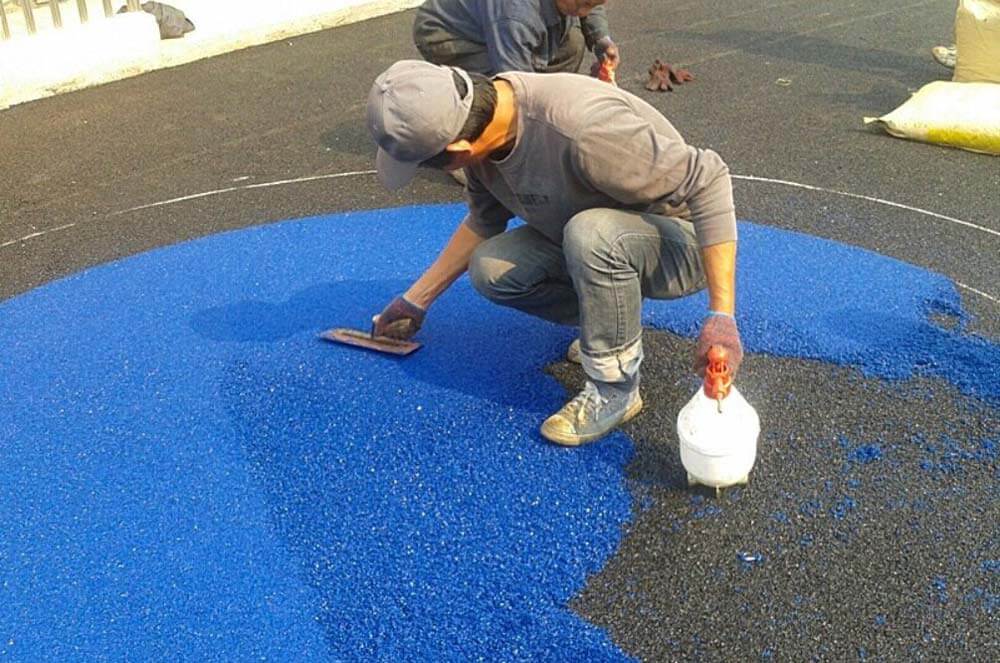
Scopes of crumb rubber coating
-
- kids' playgrounds;
- stadiums and courts, running tracks;
- sports and playgrounds;
- summer cottages;
- parking lots;
- commercial centers;
- production sites;
- storage rooms.
Increased safety requirements are imposed on coatings: protection against impacts, bruises, sprains and fractures.
Choosing a base
To obtain a high-quality and durable coating, you need to thoroughly approach the choice of the base and its preparation. Laying of crumb rubber cover is made only on a hard or tamped surface. Asphalt, reinforced concrete, wood flooring are ideal options. If this is land, then a multi-layer bulk foundation is permissible: geotextile, sand cushion, crushed stone. All this should be well tamped.
Temperature and humidity during installation
Work on laying the coating should be carried out at an ambient temperature of +15 to + 30 °C, except for low-temperature glue, which interacts well with the filler at a temperature of 3 °C. The temperature of the base, crumb, adhesive must also be within the specified range.
Air humidity 40-70%. Surface preparation and installation in rain is not permitted.
Surface Preparation
The surface must be free of dirt that hinders adhesion. If the laying is done on concrete, then it is necessary to mechanically clean the slab from the milk released during the concrete hardening, and then dedust it. When laying on freshly laid asphalt, degrease the surface, remove oils with water and dry.
The base should be carefully primed with the primer "RPC Primer PU-RC (1K)". Wait 1-1.5 hours for the solvent to evaporate. The primer colors the surface, making the primed areas distinguishable. In places where, after a lapse of time, the soil is completely absorbed into the base, the primer treatment must be repeated. In order to avoid delamination of the coating, priming is carried out over the entire area. Primer consumption is 100-400 g/m2. The primed areas remain sticky for three hours, during which time a mixture of crumb rubber and binder must be applied.
The crumb must be dry and dust-free - so the glue consumption will be minimal, and the quality of the coating is high.
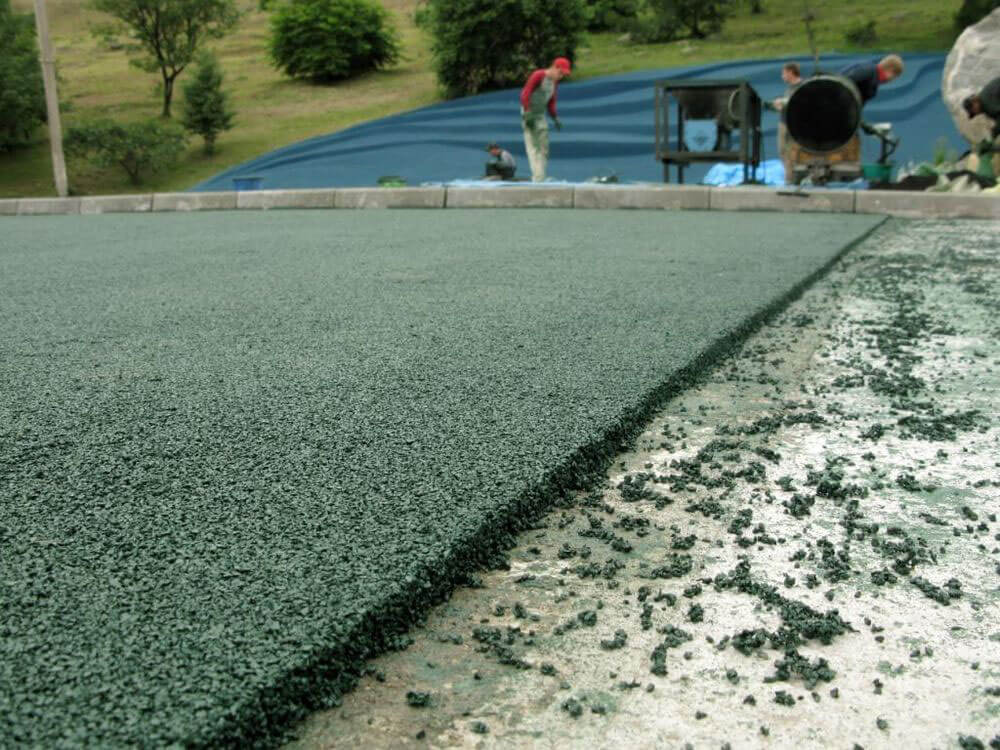
Application technology
The application is carried out in special protective suits, respirators, gloves and goggles. Ventilation is required in confined spaces.
- Mixing the components requires a large container and mixer. The crumb rubber is loaded first, mixed for 3 minutes in order to break up the lumps.
- Then the pigment is used to add color if necessary. Mix for 15 minutes to evenly distribute the pigment throughout the crumb.
- Adding an adhesive - 19-21% by weight of crumb and pigment. Stir for 5-7 minutes. Consumption for a coating thickness of 10 mm will be 8 kg of black chips and 1.5-1.7 kg of glue per square meter.
- The surface of the instruments is treated with turpentine so that the mixture does not stick to them.
- Spread the mixture evenly over the base. We compact with a hand roller or a stacking machine.
- Tack-free polymerization of the adhesive takes about 10 hours (at 25 °C). During this time, the finished coating should be covered from possible rain. The set of strength, sufficient for pedestrian loads, occurs within 2 days. Final drying within 5 days.
Accurate adherence to the preparation and application technology, as well as the proportions of the components, is the key to obtaining a quality coating.
Benefits of seamless coating:
-
- resistance to wear and shock loads;
- the ability to lay on a surface of any shape;
- simple mounting;
- water permeability prevents water from accumulating and forming puddles;
- the coating does not slip;
- does not require special care during operation;
- lifetime is 10 years;
- maintainability;
- frost resistance;
- wide choice of colours;
- noise reduction.


