

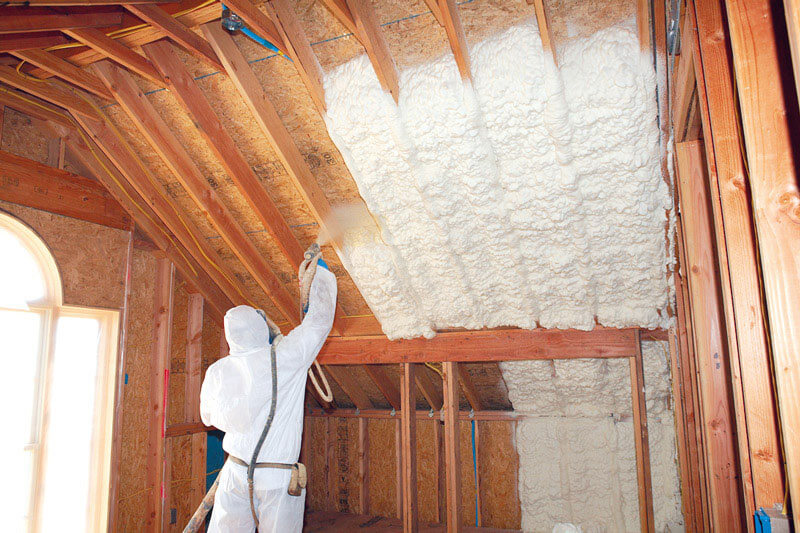
Among the insulation materials available on the market, such as polystyrene foam, expanded polystyrene, expanded polyethylene, basalt fiber, expanded clay, a significant niche is occupied by polyurethane foam (hereinafter PPU).
Obtaining polyurethane foam insulation material
Polyurethane foam is a polymer material obtained by the interaction of a polyol component (A) and an isocyanate component (B). The PPU spraying process consists in metering two components in a predetermined proportion under pressure into a mixing gun for spraying, where, under the action of compressed air, highly efficient instant mixing of the components occurs. Then the mixture is sprayed onto the surface in the form of an aerosol torch. Immediately after application, there is a sharp increase in foam volume. The foam hardens to form a monolithic thermal insulation coating. It should be noted that separately, both components are toxic, but as a result of polymerization, an environmentally friendly material is formed.
Polyurethane foam is applied to any surface: metal, wood, plaster, brick, roofing felt, tiles, except for polyethylene. The surface to be applied must be dry, dust-free and grease-free. Crumbling and shattering areas should be removed. Polyethylene is used to protect windows, doors, floors, furniture from foam.
PPU application is carried out in special protective suits, respirators, gloves and goggles. The spraying operator performs work at a distance of 0.5-1.0 m from the surface, directing the flow strictly perpendicularly, evenly, leaving no cracks or gaps, cut off excess foam. The thickness of the foam layer per 1 pass is 10-50 mm, depending on the density of the sprayed polyurethane foam.
It is important that the starting components are fed into the mixer in the prescribed proportion. Violation of the proportion will negatively affect the quality of the foam. An increase in the amount of isocyanate leads to the brittleness of the foam, and vice versa, with an increase in the amount of polyol, the foam becomes excessively elastic, which leads to compression of the foam, peeling from the surface.
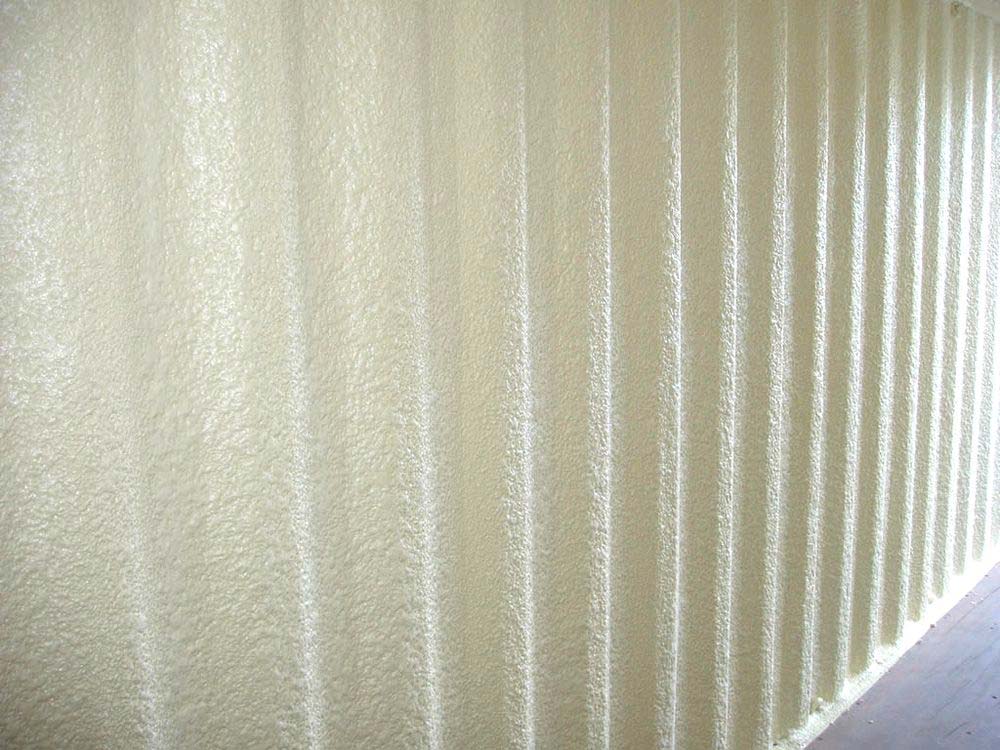
Types of polyurethane foam
Sprayed PU foam used as thermal insulation differs in the type of cell - open and closed, and in density - from 8 to 110 kg/m3.
Open-cell, lightweight polyurethane foam, has a density of 8-20 kg/m3, in terms of thermal conductivity is comparable to mineral wool, but has a higher sound insulation, and is used to insulate internal partitions, complete with hydro and vapor insulation, since it is hygroscopic (like mineral wool cotton wool).
Closed-cell polyurethane foam, density from 25 kg/m3 is not hygroscopic, does not require additional layers of vapor barrier, it is used for thermal insulation of external walls.
|
PU foam density, kg/m3 |
Thermal conductivity coefficient, W/(m•K) |
Scope of application |
Resistance to mechanical loads |
RPC component names |
| 8-20 | 0,035-0,040 | for sound and heat insulation of internal partitions |
not stable |
RPC NV-103 |
| 20-25 | 0,030-0,036 | for sound and heat insulation of internal partitions, as well as external ones when using additional waterproofing |
not stable |
RPC NV-203 |
| 30-35 | 0,020-0,026 |
external and internal heat and sound insulation, insulation of foundations, with a backfill depth of up to 3 m |
weak loads |
RPC NF-303 RPC NV-303 RPC NV-302 |
| 40-55 | 0,022-0,028 |
external and internal heat insulation, insulation of foundations, with a backfill depth of up to 3 m |
light loads, allows infrequent walking |
RPC NF-403 RPC NV-403 RPC NV-402 RPC NV-401 RPC NF-503 RPC NV-503 RPC NV-502 RPC NV-501 |
| 60-90 | 0,028-0,034 |
external and internal heat insulation, insulation of foundations and operating |
resistant |
RPC NF-603 RPC NV-603 RPC NV-602 RPC NV-601 RPC NF-803 RPC NV-803 RPC NV-802 RPC NV-801 |
| 95-110 | 0,035-0,040 |
external and internal heat insulation, insulation of foundations and operating roofs |
resistant |
RPC NF-1003 RPC NV-1003 RPC NV-1002 RPC NV-1001 |
The best thermal insulation properties are possessed by polyurethane foam with a density of 30 to 50 kg/m3.
The effectiveness of polyurethane foam as insulation
When choosing a layer thickness, one must take into account the climatic zone, the purpose of the insulated structure, the initial and required temperature and humidity.
When calculating the required amount of PPU, for the insulation of buildings and structures, you need to refer to SNiP 23-02-2003.
Rreq = a*Dd + b
Dd = (Tint – Tht)*Zht
Δ=Rreq*λ
Rreq – heat transfer resistance
a и b – coefficients (SNiP 23-02-2003)
Dd – heating season degree-day
Tint is the required temperature inside the building
Tht - average air temperature outside the room
Zht - duration of the heating period
Δ - thickness of the polyurethane foam layer
λ - thermal conductivity
The above formula calculates the heat transfer resistance for the entire building. To obtain the resistance to heat transfer only for PU foam, it is necessary to subtract the resistance of other materials from the total, for example, plaster, putty, etc. Insulation with polyurethane foam allows you to use the thinnest layer of thermal insulation in comparison with other heaters, since its thermal conductivity is lower. When comparing polyurethane foam with a thermal conductivity coefficient of 0.022 W/(m•K), for example, with mineral wool, which has a thermal conductivity coefficient of 0.052 W/(m•K), we obtain a ratio of 0.052/0.022 = 2.36. A 10 cm layer of mineral wool corresponds to a PU foam layer of 4.2 cm.
Thermal calculators are used to calculate the required thickness of the insulation.
Benefits of polyurethane foam
-
- application on surfaces of any shape;
- lack of thermal bypasses;
- application technology eliminates gaps, voids and cracks;
- reliable adhesion to surfaces;
- the service life with unchanged characteristics is 25 years, then the thermal conductivity increases insignificantly, the total service life is 30-40 years;
- high speed of work on insulation;
- polyurethane foam does not support combustion;
- space saving: 50 mm of polyurethane foam replaces 150 mm of mineral wool;
- low transportation costs: the volume of the initial components increases 10-100 times, depending on the selected density;
- resistant to fungi and moisture.


