

System Description
|
Apparent density, kg/m3 |
30-35 |
|
Core bulk density, kg/m3 |
42-45 |
|
Flammability rating |
G-2 (according to Russian GOST) |
|
Yield from the set, m3 |
10,5-11 |
|
Blowing agent |
Water |
System Description
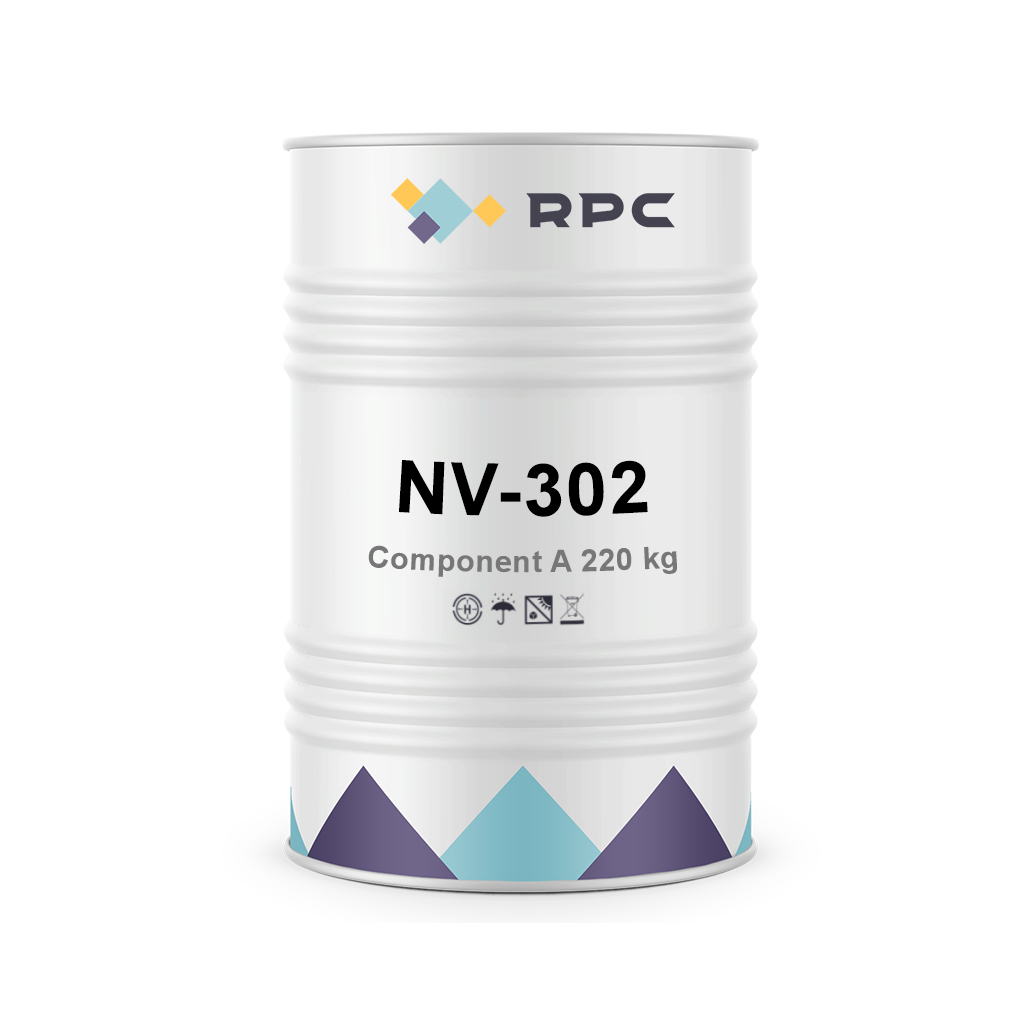
Two-component system for the production of rigid polyurethane foam by spraying of the "RPC NV-302" brand.
The polyol component (component A) of the RPC NV-302(A) trademark contains polyesters, stabilizers, catalysts, flame retardants, and water.
Isocyanate component (component B) - polymeric diphenylmethane diisocyanate grades: Lupranat M 20 S, Millionate - MR 200, Wannate - PM 200, Desmodur VKS 20 F, Ongronat 2100, etc.
Scope of application
RPC NV-302 is used for the production of rigid polyurethane foam for seamless thermal insulation by spraying residential and industrial buildings, attics and other structures, thermal insulation of pipelines, industrial refrigerators and cold rooms.
Features
- apply at a temperature not lower than + 10 °C;
- in terms of fire resistance, it belongs to the G2 category (moderately flammable) according to GOST 30244-94.
Physicochemical indicators of components A and B
|
Polyol component (RPC NV-302(A)) |
Isocyanate component (Component B) |
|
|
Density at 20 °C |
1.05-1.15 g/cm3 |
1.22-1.24 g/cm3 |
|
Viscosity at 20 °C |
150 - 350 mPa·s |
150 - 250 mPa·s |
|
Warranty storage period: |
12 months |
|
Beaker foaming laboratory parameters
|
Parameter name |
Value |
|
Cream time, s |
2-3 |
|
Rise time, s |
12 — 20 |
|
Free rise density with free foaming, kg/m3 |
30 — 35 |
|
Component temperature, °C |
22 — 24 |
|
Mixing ratio by volume |
100 to 100 |
Preparatory measures before starting work
- Heat component A to +30 - 35 °C;
- Heat component B to +40 - 50 °C;
- Stir component A with a paddle mixer for 30 minutes at 500 - 1000 rpm;
- The isocyanate component (component B) does not require stirring if it has been stored at a temperature not lower than + 15 °C. If the isocyanate component was stored at temperatures below + 15 °C, then slowly heat it up to a temperature not higher than +50 °C;
Work surface requirements
- The surface must be dry, clean, dust-free, free from oils, crumbling and chipping areas.
- If the surface cannot be completely dedusted, then it is necessary to apply a primer.
Recommendation on spraying
When spraying polyurethane foam, it is necessary to control the thickness of the layers. In one pass, apply a layer of no more than 25 mm so that the gases that are released during the foaming process have time to escape, the cells are uniform without breaks and voids. The polymerization process is accompanied by a release of temperature. If layers over 25 mm are applied, interlayer overheating is possible, which will lead to the formation of voids.
If the surface temperature for spraying is below + 15 °C, then it is necessary to apply a polyurethane foam primer layer no more than 2 mm thick, wait until the primer layer becomes elastic, then apply the main layers. The primer layer will improve the adhesion of the PU foam to the substrate and will increase the foam rise of subsequent layers.
Recommended temperature conditions:
- component A (Polyol) from +30 °C to +35 °C;
- component B (Isocyanate) from + 40 °C to + 50 °C;
- hoses from + 40 °C to + 50 °C;
- air temperature in the working area and surface not less than +10 °C;
- surface moisture should not exceed the following values:
- concrete - no more than 4%;
- cement-sand - no more than 5%;
- wooden - no more than 12%.
Precautions and health effects
When processing, it is necessary to take into account safety measures according to TU.
Physical and mechanical properties
|
Parameters |
Value |
Unit of measurement |
Test method |
|
Density (in the core) |
42 — 45 |
kg/m3 |
GOST 17177-94 |
|
Compression strength at linear deformation 10% |
0,2-0,23 |
N/mm2 |
GOST 17177-94 |
| Flexural strength | 0,28-0,32 |
N/mm2 |
GOST 17177-94 |
|
Water absorption by volume after 7 days |
no more than 5 |
% | GOST 20869-75 |
| Теплопроводность | 0,023-0,025 |
W/(m*°C) |
GOST 7076-99 |
Actual consumption of components per 1 sq. m.*
|
Temperature, °C |
Thermal insulation thickness, cm |
Component consumption, kg |
| +20 — +30 | 5 | 2,1-2,25 |
*Actual consumption will vary depending on ambient temperature, surface type, installation brand, operator experience, humidity, etc. For calculations, we recommend taking the upper flow limit.
Shelf life
The shelf life of component A is 12 months without opening the drums.
Rights
The data provided in this technical information is based on our current technical knowledge and experience and is believed to be accurate at the time of publication. Nothing in this publication should be construed as a warranty, either expressed or implied. Due to the abundance of factors that can influence the recycling and use of our materials, they do not excuse the recycler from its own testing and experimentation. In all circumstances, it is the user's responsibility to correctly determine the applicability of such information or of the product itself for a specific purpose of the user.
| Apparent density | 30-35 |